
How do you make bowling cool? (A U.S. Air Force Services Case Study]
- Jon Račinskas
- Aug 18
- 3 min read

Updated: Aug 18
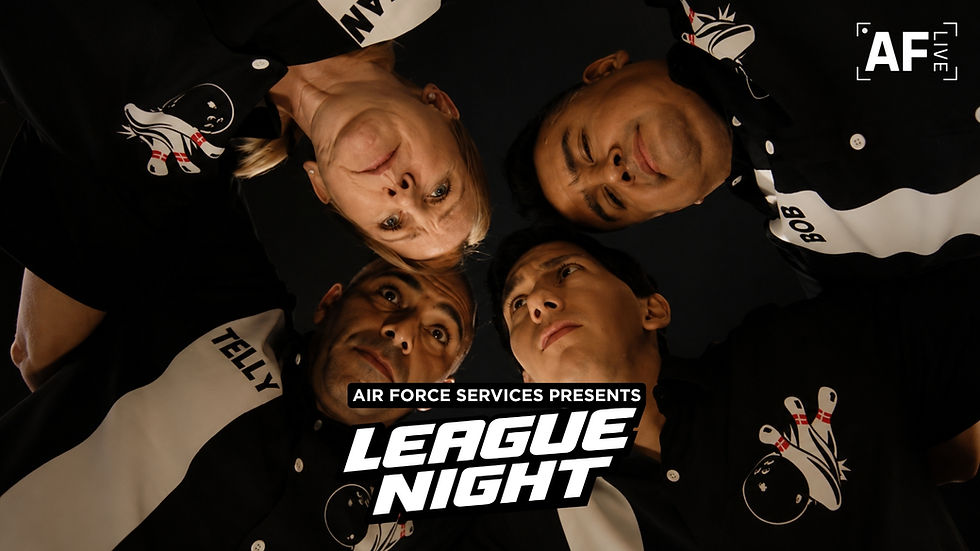
The U.S. Air Force was facing an interesting challenge. A generation of Airmen accustomed to living online was increasingly spending its off-duty time behind screens, affecting the kind of informal social connection that helps build community and morale on an installation.
At the same time, Air Force Services maintained more than 80 bowling facilities around the world. These represented a significant investment in infrastructure specifically designed to give Airmen and their families places to gather, socialize, eat, compete, and spend time together. The facilities were already there. The challenge was giving a new generation a reason to use them.
The brief seemed straightforward: develop a campaign that would encourage Airmen to join bowling leagues.
There was only one awkward question: how do you make bowling cool?
Discover
Younger Airmen had no shortage of entertainment competing for their attention. Gaming, streaming, social media, and online communities were immediately accessible the moment they went off-duty. Bowling required considerably more effort: leave the dorm, organize some friends, go somewhere, rent ugly shoes, and voluntarily participate in a sport whose cultural heyday wasn’t exactly yesterday.
Trying to compete by presenting bowling as edgy or aspirational would have felt forced. The more interesting opportunity came from understanding why people join leagues in the first place.
The appeal wasn’t so much bowling but, rather, everything surrounding it: teammates, rivalries, terrible team names, inside jokes, competition, beer, trash talk, and the peculiar phenomenon of otherwise rational adults becoming intensely invested in knocking over ten pins.
That gave us somewhere much more interesting to go.
Align
We leaned into bowling’s uncoolness. The shoes could be ugly. The shirts could be ridiculous. The team names could be terrible. Nobody needed to look like a professional athlete. In fact, taking bowling far too seriously became part of the joke.
That idea became League Night, a campaign built around the personalities and social rituals that emerge when a group of friends decides to become a team.

The creative celebrated camaraderie, rivalry, humour, and glorious mediocrity. Airmen didn’t need an existing interest in bowling to understand the proposition. League Night offered an excuse to grab some friends, get out of the dorm, and have somewhere to belong on a Tuesday night.
That also gave us a tone capable of speaking to younger Airmen without sounding like the Air Force was desperately trying to speak to younger Airmen. Self-awareness mattered.
Activate
League Night became an integrated campaign that bowling centres could use to recruit teams and build local participation. The visual identity, photography, writing, digital content, social assets, environmental graphics, and promotional materials all shared the same irreverent personality.
League Night was supported by a large production team, but I remained unusually hands-on throughout the campaign. In addition to serving as Creative Director, I wrote, directed, and edited the video series and was the primary designer responsible for translating the campaign concept across its visual identity and supporting materials. Working across strategy, design, and production allowed the original idea and tone to remain consistent from concept through execution.
Because the Air Force operates installations around the world, the system also needed to work at scale. More than 80 bowling facilities could draw from a common campaign platform while adapting materials to their own leagues, schedules, and communities.
That consistency gave individual bowling centres access to a level of creative they couldn’t reasonably be expected to develop independently, while still leaving enough flexibility for League Night to feel local.
The Outcome
League Night gave the Air Force a contemporary platform for encouraging Airmen back into spaces that already existed to support community and morale.
More importantly, the project addressed a behavioural transition that extended well beyond bowling. Digital entertainment had made isolation extraordinarily convenient. Creating stronger physical communities meant giving people compelling reasons to leave those individual environments and spend time together.
Bowling happened to provide the infrastructure. League Night supplied the invitation.
League Night episode thumbnail League Night episode thumbnail League Night episode thumbnail League Night episode thumbnail League Night episode thumbnail League Night episode thumbnail
What this project reinforced
Behaviour change depends on understanding what people genuinely value. Audiences are remarkably good at recognizing when marketing is trying too hard to manufacture relevance, particularly younger audiences.
We could acknowledge every awkward, unfashionable thing about bowling and have fun with it. That honesty opened up a much richer creative territory built around friendship, competition, humour, and belonging.
And somewhere along the way, bowling became kind of cool.
Not really. But it's a nice thought.
Comments